

Bookish
Main Street Books & Second Flight Books win Greater Lafayette Commerce’s Small Business of the Month nod


By Shelby White | Photos by Jennifer Boss | Video by Brooke Cleaver
There are people who read one book at a time, dutifully, from first page to last, and then there is Laura Kendall, who at any given moment is reading about eight.
She starts one, then a book club she runs requires another, the first gets set down until she rediscovers it weeks later, mildly surprised. It is not carelessness, nor forgetfulness, nor any real want of discipline. It is the surest sign of a genuine reader, and a genuine reader is precisely the sort of person you want choosing the books in a book shop, which Kendall has been doing, with great devotion, for the better part of a decade.
Kendall owns two bookstores in Greater Lafayette, which makes her unusual twice over. Most independents are a single store, and independents were, for years, supposed to be a dying breed. Neither has held up.
She built Second Flight Books with her husband Justin and took over Main Street Books after its founder died, keeping a downtown fixture from closing, and they did it in the middle of an unlikely national comeback: 605 new bookstores opened in 2025 against 65 closings, per the American Booksellers Association, with the sector up about 70% since 2020. Greater Lafayette Commerce named her two stores its Small Business of the Month this month.
Allison Hill, who runs the American Booksellers Association, has said that strangers still offer their condolences when she tells them what she does, on the assumption that the stores are vanishing. They are not vanishing. What they are doing, mostly, is two things an algorithm can’t: gathering people in a room, and putting the right book in a specific hand.
Kendall does the second one from memory. She has a customer at the other store who has been shopping with her since close to the month it opened, nearly a decade of accumulated preferences, and when Kendall works through a publisher’s catalog, she finds herself flagging titles by name.
“I’ll be like, oh, Sue would like this one,” she said. “I better add this one to my list.”
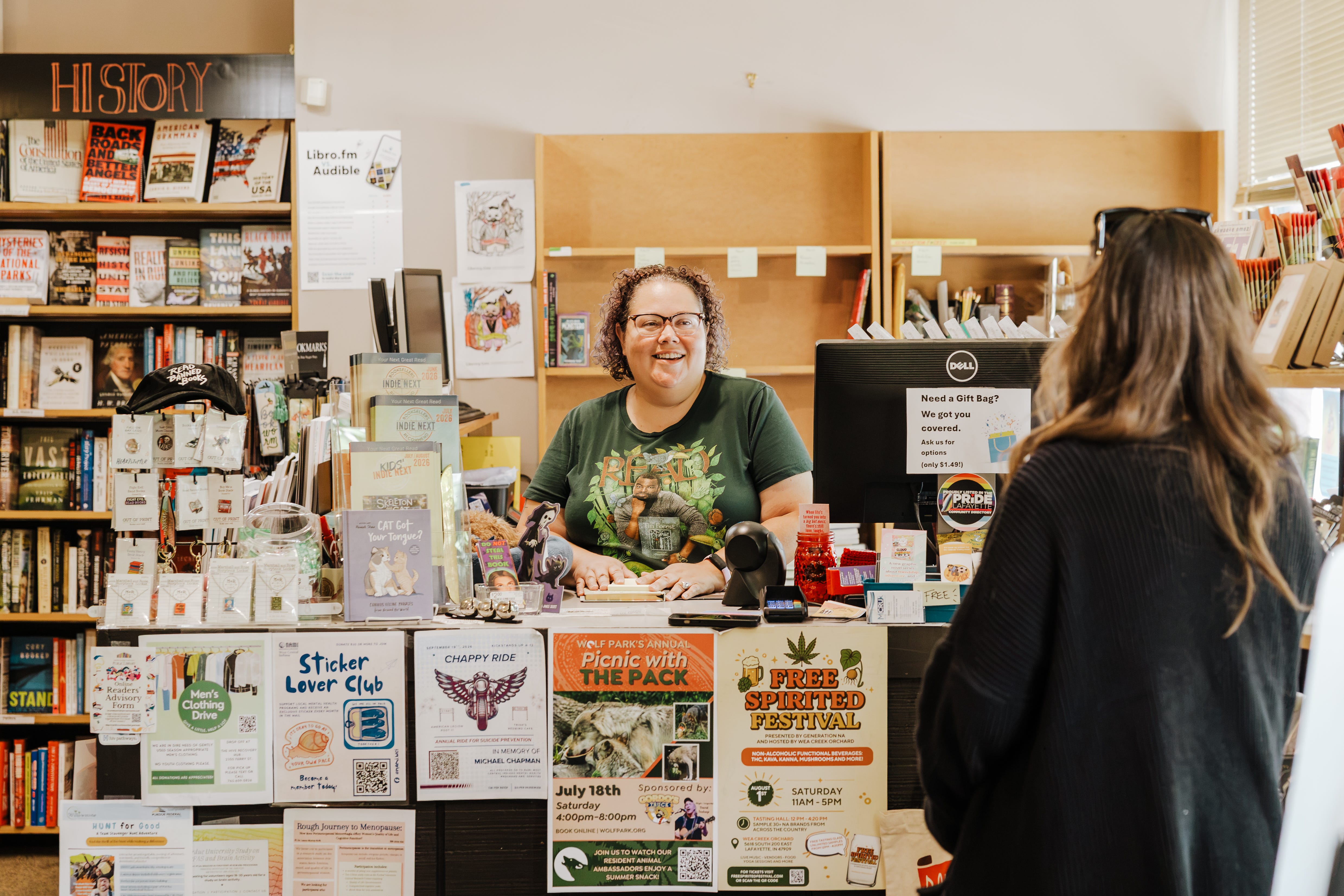
She did not set out to do any of this. She grew up in La Porte, studied journalism at Ball State and interned at NUVO, a newspaper in Indianapolis during a recession that had no interest in hiring young reporters.
Kendall worked for the state instead, earned an MFA in writing at Butler and spent a few years in India with Justin. When they came back, they took over a used bookshop on Earl Avenue that was closing, its lease nearly up and no plan for the inventory.
“It was pretty much us or the dumpster,” she said.
They didn’t have much money, so they offered what amounted to a rescue: give us the shelves and the stock, and we’ll try to make a bookstore. The owners agreed. That was Earl Avenue Books, all used, about 10 years ago. It moved to Market Square, then to a building near the park that the Kendalls bought in 2020, and somewhere in there it became Second Flight.
Main Street Books they did not build. Tamzin Malone, its founder, had opened Main Street Books downtown about a year and a half before the Kendalls opened Second Flight Books, and Malone was generous with what she knew, down to which point-of-sale system to buy.
When the Kendalls were setting up Second Flight, Malone gave them a table she wasn’t using.
“I have this,” Kendall remembered her saying. “I’m not using it. Just take it.”
Malone died in 2021, in her 50s, of a cancer that moved quickly. Her husband kept the store going for a year with help from friends and staff, then asked the Kendalls if they wanted it. They thought about it for a few months. Almost four years ago they said yes, and they kept the name.
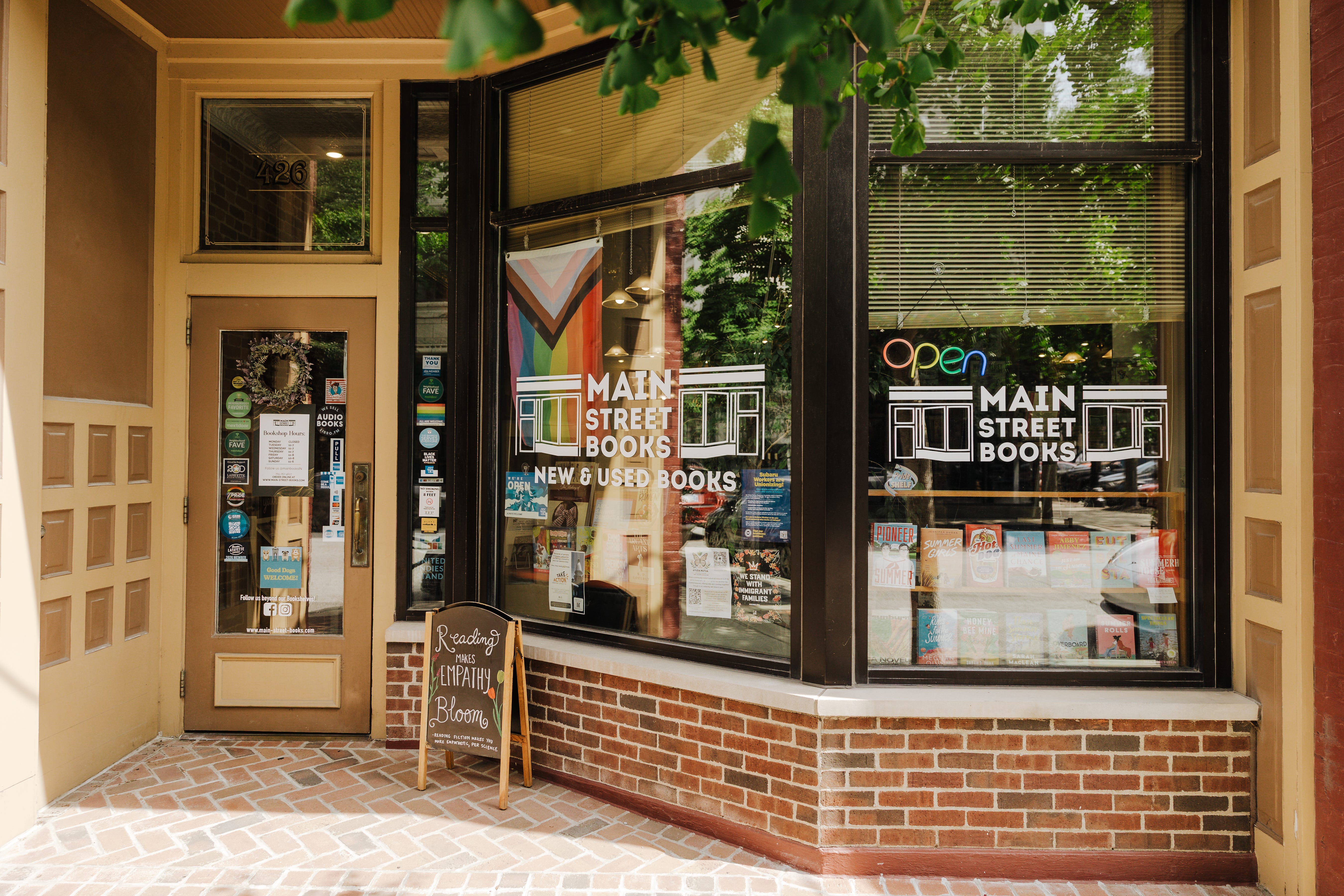
“It felt a little bit rude to change it,” Kendall said.
Keeping the name did not mean keeping everything. Under Malone, the store had been almost entirely used books. The Kendalls looked at the downtown foot traffic, the people who come to browse rather than hunt, and pushed it the other way, until it ran about 70% new. They also widened the gift section, the cards and stickers and small bookish objects, which is partly taste and partly arithmetic.
A bookstore buys its books from publishers at around 40% off the cover price and keeps a net margin that runs, in a good year, somewhere in the low single digits. Stickers and gifts carry margins several times that, which is why nearly every independent that has survived the last decade keeps a shelf of them near the register.
It is the same reason the events matter. A store that fills its calendar with readings and clubs is not being sentimental. It is protecting the one dependable line on the ledger, which is the reason people come in at all.
Kendall watches the machinery upstream of the register closely, because it keeps changing under her. Publishers’ catalogs run 50 titles to a page, and she orders four to six months out, buying for fall while it’s still summer.
Lately the change she notices most is at the cheap end. The mass market paperback, the small rack-sized format that once put fiction in drugstores and airports for a couple of dollars, is being retired; the country’s largest distributor of them, ReaderLink, stopped carrying the format at the end of 2025, and unit sales had already fallen more than 80% over two decades, according to Circana BookScan.
Publishers have shifted toward the larger trade paperback, and increasingly toward trade paperback originals, which spare a reader the year-long wait for a paperback and the $30 hardcover in the meantime.
“It makes more things more accessible,” Kendall said. She talks about children’s books this way in particular, where a $20 hardcover is a bet a parent shouldn’t have to place on a kid who may not like the thing.
Most of what the store does is about what it lets in, and it is built to be easy to say yes to. The book clubs are designed that way on purpose.
One meets around titles of 200 pages or fewer, for readers who are slow or just busy; another, run with the library, lets people read whatever they like and come report on it. Kendall doesn’t require anyone to buy the book to attend.
Turnout runs from a handful to a dozen, sometimes past 20. She isn’t from Lafayette, and most of the friends she has made here came to her over the counter, a few of whom now join her on an annual bookstore road trip; this spring it was St. Louis.
The curation is a group effort. The crowd at Main Street Books runs speculative, so the shelves go deep on science fiction, fantasy and horror, alongside LGBTQ titles and the translated “healing fiction” arriving from Japan and Korea, and the staff write the shelf-talkers, the small clever notes detailing why this may be the book for you.
There is a greeter now, too. Archie, a small, curly, apricot-colored rescue she took home in January, has a pick of the week, usually a book with an animal on the cover or a pun in the title.
Kendall has been a reader all her life, but reading is a solitary thing, and the store gave her the part that isn’t, the people who turn up needing the same thing she does and stay to talk about it. It is why she is still behind the counter after a decade, and why, when you ask her what the job has given her, she does not mention the books.
“Book people,” she says, “are just awesome.”
 | A guest post by
|
 | A guest post by
|
 | A guest post by
|
Both wonderful bookstores Lafayette is lucky to have!