

Slow Burn
Studio Green 557 brings handcrafted pyrography to Lafayette Farmers Market


Matthew Rottler grew up watching his grandfather paint pictures of nature after dinner. The urge to make something by hand, he would find out, is the kind of thing that gets passed down.
That inheritance found its way, eventually, to a burning iron and a piece of wood, a different medium than his grandfather’s, same instinct.
The path between that kitchen table and where Rottler stands today was not a straight one. Rottler studied drawing and photography at Jefferson High School, developing an eye for composition and light. Then he left Lafayette for Orlando, trading the flat Midwestern horizon for the humid sprawl of central Florida, where he enrolled in a school dedicated entirely to digital animation and visual effects.
There, he learned to construct worlds from nothing, to give texture to surfaces that existed only as code, to create the illusion of weight, time and consequence in a medium that had none of those things in any physical sense. He graduated in 2011, started his business Studio Green 557, then made his way home to Indiana.
Today, Rottler brings both worlds together through Studio Green 557, a Lafayette-based business that combines digital visual-effects work with handcrafted pyrography. His work bridges cutting-edge technology and one of humanity’s oldest art forms, creating custom wood-burned pieces inspired by nature, local history and pop culture.
At the Lafayette Farmers Market, his wood-burned artwork reflects a growing demand for handmade goods and the personal connection that comes from knowing who made them in an increasingly digital age.
What he built here was not a retreat from any of that. Studio Green 557 is, by Rottler’s own description, a multimedia company — photography, video, 2D and 3D visual effects, green screen work — that also happens to burn things into wood.
He shows up at the farmers market and at Lafayette Comic Con with equal comfort, photographing cosplay crews against green screens one weekend and pressing a heated iron into a piece of wood the next.
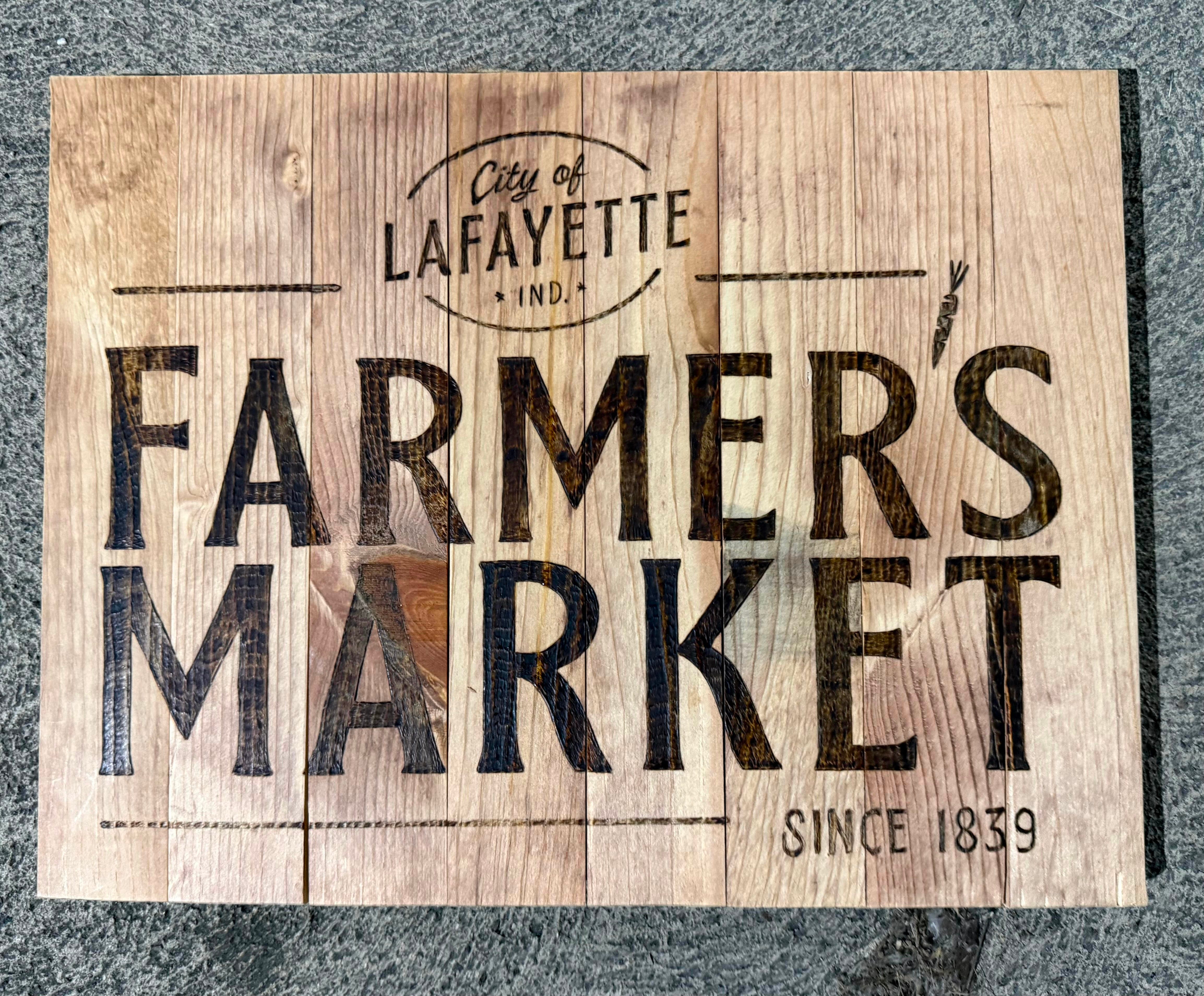
Pyrography’s defining constraint is also its defining virtue. Every mark the iron leaves is permanent. The work accumulates visibly, scar by scar, and it keeps its record in a way that no digital file ever truly does. A file can be duplicated without loss and altered without evidence. The burn stays.
What Rottler sells at his booth is not decoration, exactly. It is proof that a person was there.
“One thing customers may not know is the amount of time it takes to create each piece of art,” he says. “It is all handcrafted. Each piece presents a different challenge.”
That challenge begins with the material itself.
Wood is not a neutral medium. It has grain and density and moisture content, and it pushes back. The pyrographer has to read it, respond to it and adjust. A knot in the wrong place becomes a problem to be solved or a feature to be absorbed into the design. There is no undo button. It is a negotiation between an artist and a specific surface, on a specific day, with a specific idea that may or may not survive contact with the material.
The U.S. handicrafts market reached an estimated $345 billion in 2025 and is projected to nearly double over the next decade, driven by consumers hungry for handmade objects, according to Imarc Group, a management consulting firm. Wood-based artwork and décor remain among the strongest-performing segments within that market. What people are buying, when they buy handmade, is a relationship to time — someone else’s time, spent on their behalf.
Rottler has been a vendor at the Historic Lafayette Farmers Market for four years, long enough to become a fixture in the ecology of a Saturday market.
“Matthew came back to Lafayette with a degree in digital animation and years of visual effects work behind him and built something really cool in Greater Lafayette — a business that is equal parts visual effects studio and handcraft, and entirely his own vision,” said Mikel Berger, president and chief executive of Greater Lafayette Commerce, which organizes the Lafayette Farmers Market.
Rottler’s work ranges from colorful nature-inspired pieces and custom commissions to personalized gifts. But he describes the business in terms that go beyond inventory.
“The weekly time to see our customers and fellow vendors,” he said.
This season, Rottler is at work on his most ambitious project yet: a collection of pieces commemorating the bicentennial of both Lafayette and Tippecanoe County. Two hundred years of local history, rendered in heat and patience, on surfaces that will hold the record permanently. There is something fitting in that, a medium defined by its permanence asked to carry the weight of a place’s origin story.
On Saturday mornings, you can find Studio Green 557 at the Lafayette Farmers Market from 8 a.m. to 12:30 p.m.
 | A guest post by
|